Patterns as Guardrails: Architecture That Resists Entropy
Software systems rarely fail because a team chose the “wrong” framework.
They fail because complexity compounds faster than intent.
At small scale, discipline is optional.
At medium scale, discipline is cultural.
At large scale, discipline must be architectural.
This article describes the pattern system and dependency rules I use to keep a growing codebase understandable, testable, and resistant to entropy — even as domains expand and teams scale.
This is not “DDD for DDD’s sake.”
This is DDD as a survival mechanism.
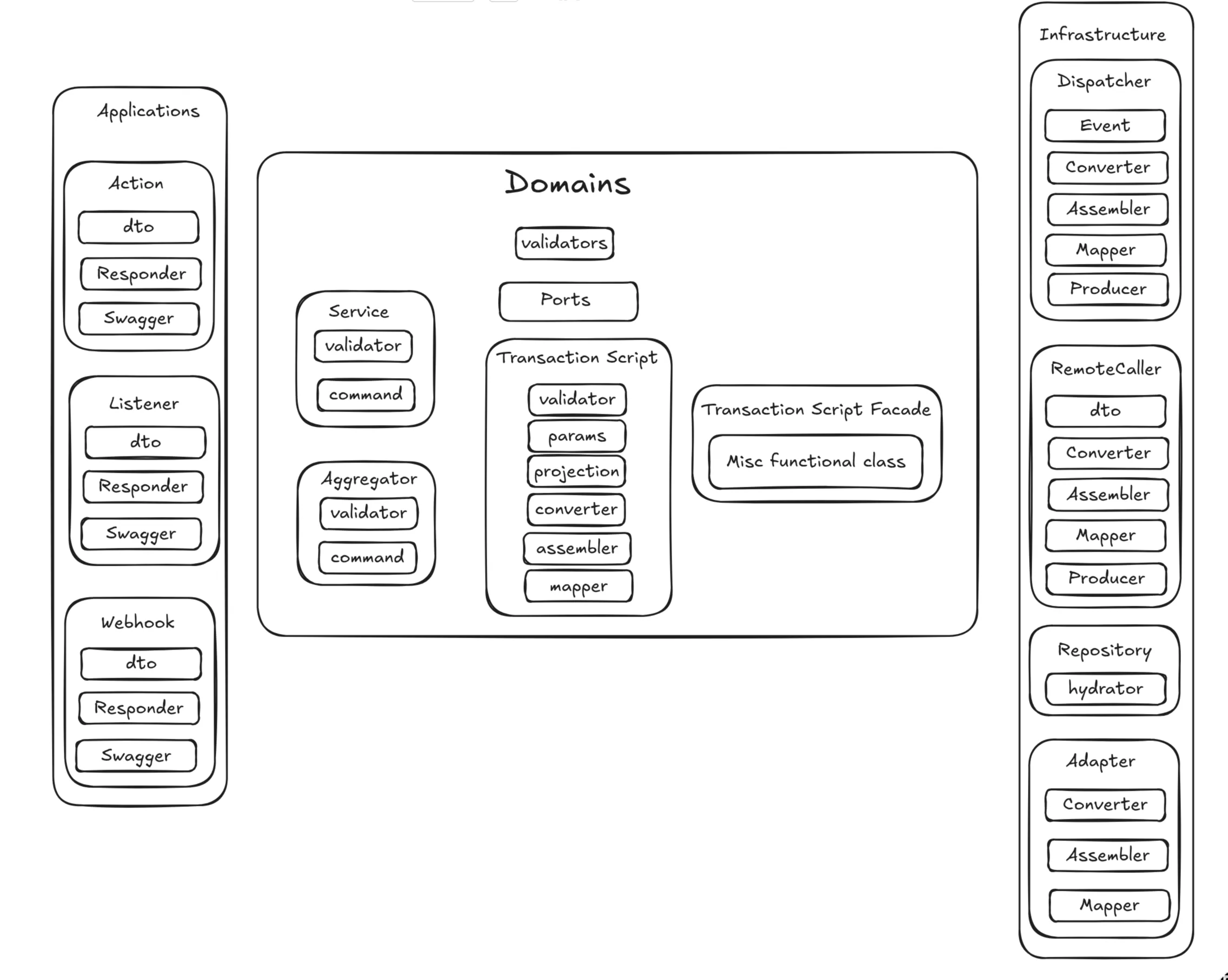
Figure: Stratified domain patterns with enforced dependency direction.
The problem: unbounded optionality
Section titled “The problem: unbounded optionality”Most systems don’t collapse suddenly. They degrade.
- Transaction logic leaks into controllers
- Repositories grow “helpful” business rules
- Services call services which call services
- Refactors stall because no one knows what depends on what
The root cause usually isn’t incompetence — it’s lack of constraint.
When everything can talk to everything, architecture becomes a negotiation, not a structure.
So the goal isn’t maximum flexibility.
The goal is directed flexibility.
The core idea: patterns define a dependency graph
Section titled “The core idea: patterns define a dependency graph”This architecture is built on a simple rule:
Every pattern exists at a specific level of abstraction — and dependencies may only flow downward.
Patterns don’t just describe what code does.
They define where orchestration is allowed to happen.
That’s the difference between guidelines and guardrails.
The high-level shape
Section titled “The high-level shape”At a distance, the system resolves into three major layers:
- Application: request/response handling, entry points, integration boundaries
- Domain: business behavior, transactions, rules, domain workflows
- Infrastructure: persistence, external IO, messaging, remote calls
The important part isn’t that those layers exist — it’s that the Domain is stratified into explicit roles instead of a single amorphous “service layer.”
The domain is not a blob
Section titled “The domain is not a blob”Instead of “a service that does stuff,” the domain is split into explicit patterns:
- Domain Services
- Aggregators
- Transaction Scripts
- Mappers
- Assemblers
- Converters
- Repositories
Each layer answers a different question.
Domain Services: orchestration, not work
Section titled “Domain Services: orchestration, not work”Domain Services exist to answer business-level questions:
- “Can this invoice be cancelled?”
- “What happens when a payment is applied?”
- “Which workflows must execute together?”
They coordinate transaction scripts and aggregators.
They do not implement low-level behavior themselves.
If a Domain Service is full of conditional logic, something is probably misplaced.
Their job is sequencing and delegation — not calculation.
Aggregators: cross-domain boundaries with teeth
Section titled “Aggregators: cross-domain boundaries with teeth”Aggregators are the primary mechanism for cross-domain communication.
They exist to:
- hide foreign models and infrastructure details
- stabilize cross-domain contracts
- prevent entity “pollution”
- keep domains from becoming mutually dependent piles
Aggregators are diplomats — not citizens.
Transaction Scripts: where business rules live
Section titled “Transaction Scripts: where business rules live”Transaction Scripts are the atomic units of business behavior.
Each one:
- handles a single use case
- owns its input validation and rules
- is independently testable
- reads like a direct story of “what happens”
If you want to understand how the system behaves, you read the Transaction Scripts.
They are intentionally explicit and procedural.
Boring is a feature.
Mappers, Assemblers, Converters: controlled complexity
Section titled “Mappers, Assemblers, Converters: controlled complexity”These patterns exist to prevent accidental orchestration.
Converters
Section titled “Converters”Converters are pure transformations:
- no dependencies
- no IO
- no business logic
- no decisions
If it needs data access, it is not a converter.
Assemblers
Section titled “Assemblers”Assemblers do data composition:
- may touch repositories
- may combine multiple data sources
- still no business rules
Assemblers answer: “What shape should this object be?”
Mappers
Section titled “Mappers”Mappers coordinate assembly:
- orchestrate assemblers and converters
- produce complex structures
- keep Transaction Scripts focused
Mappers exist so Transaction Scripts don’t grow tentacles.
The Blackbox Principle
Section titled “The Blackbox Principle”One rule keeps the entire structure sane:
If a pattern uses another pattern internally, it becomes a blackbox to higher layers.
If a Mapper uses a Converter, then a Transaction Script must use the Mapper — not the Converter.
You never reach through a layer.
You only talk to it.
This prevents dependency leakage and preserves abstraction boundaries.
Repositories: data, nothing else
Section titled “Repositories: data, nothing else”Repositories are intentionally boring.
They:
- query
- persist
- return entities or projections
They do not:
- enforce business rules
- orchestrate workflows
- publish events
- call services
When repositories stay dumb, refactors stay possible.
Application layer: entry points, not logic
Section titled “Application layer: entry points, not logic”Actions, listeners, webhooks, and responders exist to:
- validate input
- call into the domain
- shape output
They are translators — not decision makers.
Swagger belongs here.
Business rules do not.
Why this works at scale
Section titled “Why this works at scale”This system optimizes for:
- Local reasoning — you know where logic belongs
- Refactor safety — dependency direction is fixed
- Test isolation — Transaction Scripts test cleanly
- Team scaling — patterns teach newcomers how to think
- Change containment — things that change together live together
Most importantly:
It prevents cleverness from becoming architecture.
This is not dogma
Section titled “This is not dogma”You will violate these rules sometimes.
That’s fine.
What matters is that violations are:
- visible
- intentional
- discussable
Architecture isn’t here to eliminate tradeoffs.
It exists to make tradeoffs explicit.
Closing thought
Section titled “Closing thought”Good architecture doesn’t make systems faster.
It makes bad decisions harder to hide.
Patterns aren’t about purity.
They’re about protecting future engineers from present convenience.
Entropy never sleeps.
Related
Section titled “Related”- Reference → Pattern Glossary
- Transaction Scripts
- Domain Services
- Aggregators
- Repositories
- Reference → Dependency Injection Rules
- How-to → Add a Transaction Script